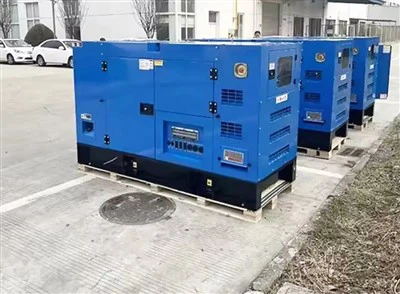

Diesel generator set noise is the primary source of noise for gas generator sets. Gas engine noise can be divided into aerodynamic noise, combustion noise, mechanical noise, exhaust noise, and oscillation noise. Aerodynamic noise primarily includes air oscillation noise caused by intake, exhaust, and fan rotation, which is directly transmitted into the air.
The pressure oscillation caused by combustion inside the cylinder passes through the cylinder head, and the noise radiated outward from the body is called combustion noise; The impact of the piston on the cylinder liner, as well as the impact oscillation noise generated by moving parts such as the valve train and jet system, are collectively referred to as mechanical noise. During unit operation, exhaust gas rushes out of the exhaust valve at high speed, enters the muffler along the exhaust manifold, and is then discharged into the atmosphere through the tailpipe. Exhaust noise is the loud noise of the engine, often about 15 dB (A) higher than the main engine noise, followed by combustion noise, mechanical noise, fan noise, and intake noise.
The main reasons for water ingress into the oil pan of diesel generators are: deformation or cracks in the cylinder head and engine body; Wet cylinder liner perforation; The water blocking ring of the cylinder liner is damaged; The engine oil radiator is damaged; Damaged cylinder gasket; Damage to the sealing ring of the water pump, etc.
1) Cracks or deformations in the cylinder body or head: mainly caused by improper use and maintenance, such as prolonged high load operation, excessive thermal load and stress; Suddenly adding a large amount of cold water to a diesel engine in a high-temperature and water deficient state; Or artificially damaged during disassembly, assembly, and transportation; Damage and cracks caused by accidents.
2) Wet cylinder liner perforation: mainly due to the direct contact between the cylinder liner and the cooling water of the diesel engine for heat dissipation. During the cooling water circulation process, the outer surface of the cylinder liner is washed away, resulting in pitting and cavitation on the outer surface of the cylinder liner. Over time, it will cause pitting and cavitation on the outer surface of the cylinder liner. Over time, dense pits will appear on the upstream surface of the cylinder liner, and in severe cases, the cylinder liner may become perforated, causing cooling water to enter the diesel engine oil pan.
3) The main reason for the damage of the water blocking ring of the cylinder liner is that the centerline of the cylinder liner is not perpendicular to the end surface of the cylinder support hole when installing the cylinder liner, and the water blocking ring is bitten by excessive force when pressing the cylinder liner; Or due to the engine running under water shortage conditions, the cylinder liner temperature is too high, which damages the water blocking ring and causes cooling water to leak into the oil pan.